
A gentle plan for training for a multi-day walk (especially in midlife)
There’s a particular kind of longing that arrives in midlife. It’s not dramatic. It’s quieter than that. A tug you feel on a normal Tuesday, when you catch yourself staring out of a window and thinking: “I’d love to feel strong again. I’d love an adventure that’s mine.” And then the other thought arrives straight behind it:
“But my knees…”
If that’s you, you’re in very good company. At WalkingWomen, many of the women who join our trips are active, capable, and full of heart — but they’re also navigating creaky joints, changing energy, busy lives, and a completely normal wobble of confidence. You don’t need perfect knees to take on a multi-day walk. You do, though, need a steady approach and a plan that builds you up gently.
This is that plan.
First: what “training” really means
Let’s take the pressure off. Training for a multi-day walk doesn’t have to be intense. For most of us, the biggest win isn’t speed — it’s consistency. You’re preparing your body (and your confidence) for:
- walking for a few hours a day, for several days
- steady effort rather than bursts
- hills, steps, and uneven surfaces
- recovering well overnight so you can enjoy the next day
If you can walk regularly now — even modest distances — you’re already on the way.
The “gentle build” approach (6–8 weeks)
This is the simplest structure we’ve seen work again and again: three walks a week, plus a small amount of strength or stability work if you can. Check out our YouTube channel for helpful videos to give you tips.
Weeks 1–2: Build the habit
Goal: get your legs used to regular walking without flare-ups.
- Walk 1 (midweek): 30–45 minutes easy pace
- Walk 2 (midweek): 30–45 minutes, include a few gentle hills or steps
- Walk 3 (weekend): 60–75 minutes comfortable pace
- Optional (twice a week, 10 minutes): balance and stability (think controlled, not sweaty)
Knee-kind tip: finish each walk thinking “I could have done a bit more.” That’s how you avoid the boom-and-bust cycle.
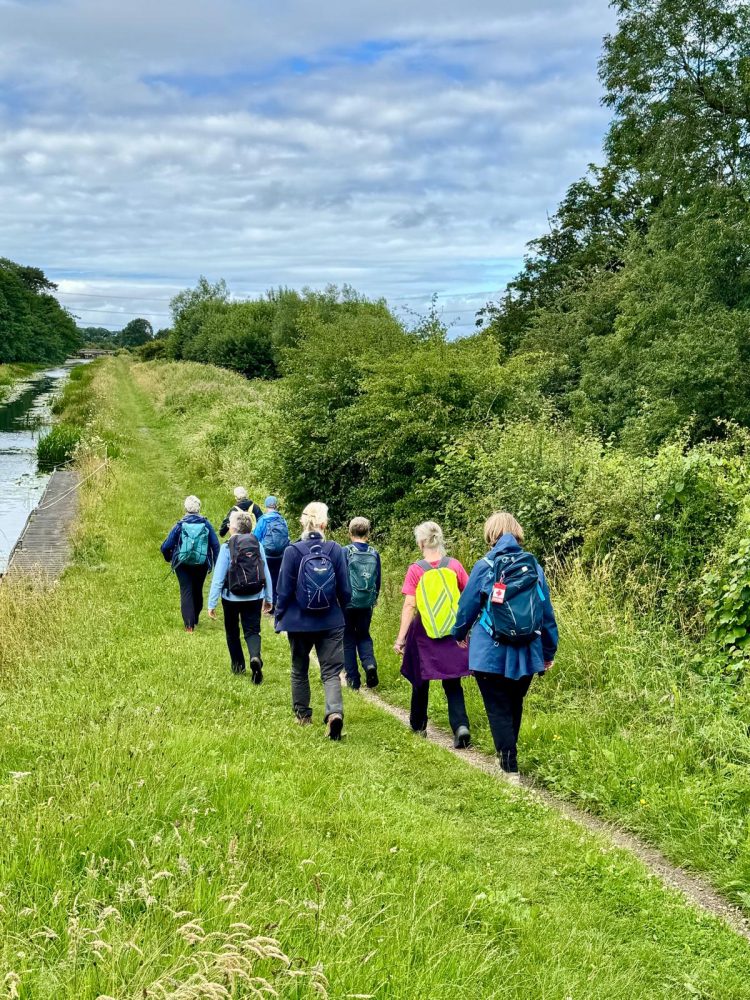
Weeks 3–4: Add steady time on feet
Goal: increase time gently and introduce “real terrain”.
- Walk 1: 45 minutes easy
- Walk 2: 45–60 minutes with a few hills or steps
- Walk 3 (weekend): 90 minutes to 2 hours
- Optional: 10 minutes strength or stability twice a week
If you can, do one walk on a surface that mimics trail conditions: coastal paths, woodland tracks, uneven ground. It’s less about distance and more about confidence on your feet.
Weeks 5–6: Make it trek-like
Goal: practise back-to-back walking (the real secret sauce).
- Walk 1: 45–60 minutes
- Walk 2: 60 minutes with hills or steps
- Walk 3 (weekend day 1): 2–3 hours steady
- Walk 4 (weekend day 2): 60–90 minutes easy recovery walk
That second day is the magic: it teaches your body you can walk again the next day — and it teaches your mind not to panic.
Weeks 7–8 (optional): Confidence and comfort
If you have time, keep the rhythm and focus on:
- walking in the boots or shoes you’ll wear
- testing socks, layers, and hydration
- practising with poles if you use them
- learning your best recovery routine (more on that below)
“But what about my knees?”
You don’t need to love hills to do a multi-day walk — but you do want to be smart about joint load. Here are the things we see make the biggest difference for “dodgy knees” walkers:
-
Slow down on descents
Downhill is often more demanding than uphill. The win is not bravery — it’s control:
- shorten your stride
- keep your knees soft
- take more breaks than you think you need
-
Consider trekking poles
Poles can reduce pressure on knees on descents and add stability on uneven ground. They’re not “cheating” — they’re a brilliant tool.
-
Train little and often
Long gaps followed by one heroic weekend walk is where knees complain. Short, regular walks are kinder.
-
Strength matters (but it can be tiny)
You don’t need a gym. A few minutes of basic strength or stability can help support knees:
- sit-to-stands from a chair
- step-ups on a low step
- calf raises
- gentle glute work (your hips do a lot of stabilising)
If you already have a physio routine, stick with that — it’s gold.
Note: If you have a diagnosed injury or specific concerns, it’s always worth checking with a professional. This is general guidance, not medical advice. Recovery isn’t indulgence — it’s part of the plan. One of the secrets of enjoying multi-day walking is what you do after the walk. If your knees (or hips, or feet) can be a little vocal, recovery is your best friend:
- a warm shower or bath
- gentle stretching
- good food and enough protein
- hydration
- sleep
- and, if you’re lucky, something like a pool, sauna or hot tub
Trips that are designed with comfort and recovery built in can make a huge difference — not because you “need pampering”, but because you’re giving your body what it needs to do the next day with more ease. (For example: if you’re considering something like our Cornwall Coast Path week, where you return each day to an indoor heated pool, sauna and jacuzzi, it can be the difference between feeling depleted… and feeling quietly proud.)

What a multi-day walking day feels like (realistically)
A lot of anxiety disappears when we talk honestly about what a day looks like. On a supportive, women-only walking holiday, you can expect:
- a steady pace (no racing)
- regular pauses
- time to take photos, chat, eat, breathe
- a group rhythm that makes you feel held, not hurried
You do not need to be the fittest person in the group. You do need to meet the baseline fitness required for the itinerary — and then let the guides and the group support you to find your rhythm.
The confidence piece (often bigger than fitness)
Here’s something we see constantly: women are stronger than they think, but they’ve forgotten it.
Training isn’t only about legs. It’s about remembering:
- You can do hard things
- You can look after yourself
- You can take up space in your own life again
That’s why multi-day walking can be powerful. It doesn’t just build fitness. It rebuilds trust in yourself.
If you’re tempted, here’s your next step
If a challenge has been sitting quietly in the back of your mind — that little “what if?” — don’t overthink it.
Start with a gentle habit:
- three walks a week
- one slightly longer walk at the weekend
- a slow, kind build
And if you’d like a bit of encouragement, tell us where you’re starting from. Are you already walking 30 minutes comfortably? An hour? Are hills the worry? Is it confidence more than fitness?
Reply to the newsletter or drop us a message and we’ll suggest a simple build-up that feels realistic for you.
Because “dodgy knees” doesn’t have to mean “no adventures”. Sometimes it just means: steady, supported, and onwards.
This article is part of a series: Trekking and challenges in later life
Over the coming months, we’ll be sharing practical, reassuring posts for women who want a meaningful challenge — without the macho culture, the pressure, or the feeling that you have to be “super fit” to belong.
If you’re curious, here are a few WalkingWomen Treks you might like to explore:
- Cornwall Coast Path (May 8) – 60 miles / 96 km from a luxurious base, with an indoor heated pool, sauna and jacuzzi.
- The Slate Trail, Snowdonia (May 30) – 83 miles / 133 km with a fun sense of achievement (and your Slate Trail passport).
- West Island Way, Isle of Bute (May 30) – 30 miles / 48 km around a beautiful Scottish island, with sweeping sea views.
- King Charles III Coast Path, Cumbria (July 4) – 65 miles / 105 km, finishing with five nights in a spa hotel.
- Slovenia: Rivers of the Julian Alps (July 6) – 56 km with glorious swim stops along the way.
- Kerry Camino, Ireland (July 11) – 35 miles / 57 km on a quieter, meaningful “hidden Camino”.
- Our Epic Trek – Lighthouse Way (Sept 14–26) – 125 miles / 200 km for women who want a truly big, life-marker challenge.
- Lower Himalayas, India (Dec 5) – a soul-stirring end-of-year adventure.
If one of these is calling you, start with this guide, take your first few steady walks — and let the confidence arrive in its own time.
This article is part of our “Walking Onwards” series — a collection of practical, reassuring posts for women in midlife and beyond who feel the pull towards a meaningful challenge. We share training tips, real trek-day insight, and stories from the WalkingWomen community to help you feel confident and supported, one step at a time.

